

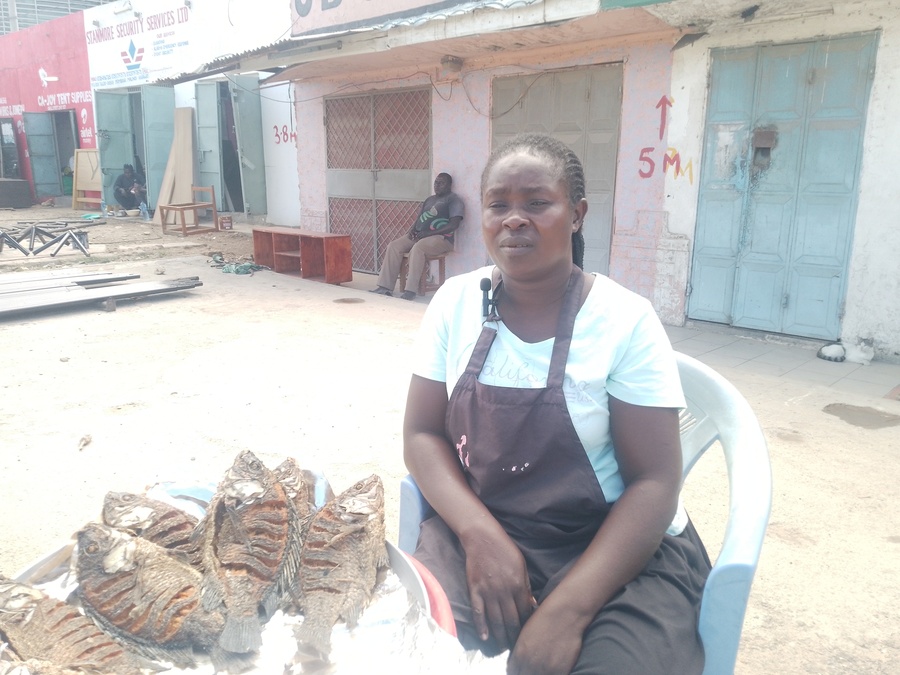
As the aroma of freshly fried tilapia drifts through a busy roadside corner in Nyali, Mombasa, Sarah Omondi carefully serves a customer before turning back to a charcoal stove sizzling with fish.
For seven years, the small-scale trader has built a livelihood from selling fried tilapia. The business has enabled her to pay rent, feed her family, educate four school-going children, and even access credit through a local SACCO. But today, Sarah’s future hangs in the balance as rising fuel prices ripple through the economy, increasing costs and squeezing profits for thousands of informal traders like her.
“Business used to be much better,” Sarah says. “Nowadays, everything is becoming more expensive, especially the fish.”
Sarah can sell up to 200 pieces of fried tilapia on a good day. Each fish traditionally sold for about Ksh 350, attracting customers from different parts of Nyali. The demand has always been strong because tilapia remains one of the most popular fish delicacies along Kenya’s Coast.
Yet behind every fish Sarah sells lies a supply chain heavily dependent on fuel.
Most tilapia consumed in Mombasa originates from fish farms in Kisumu and the Lake Victoria region, hundreds of kilometres away. Transporting the fish to the Coast requires refrigerated trucks and distributors who rely on road transport. When fuel prices rise, transport costs inevitably increase, and the burden eventually lands on traders and consumers.
According to Sarah, distributors supplying fresh fish to Mombasa have repeatedly adjusted their prices upwards to cover rising transportation expenses.
“The suppliers increased their prices because fuel has gone up,” she explains. “For me to make any profit, I also have to increase the selling price.”
The result has been a difficult decision. Sarah now sells some of her fried tilapia at up to Ksh 400 per piece.
But while the higher price helps cushion her against rising costs, it is driving away customers.
“Many people are finding it hard to afford the fish now,” she says. “Some who used to buy regularly no longer come as often.”
The shrinking customer base is beginning to threaten the very foundation of her business.
Sarah’s story reflects a wider economic reality facing countless small-scale entrepreneurs across Kenya. From vegetable vendors and food kiosks to boda boda operators and market traders, rising fuel prices are increasing the cost of transporting goods and services, forcing businesses to either absorb losses or pass the costs on to consumers.
In many cases, customers simply cannot keep up.
The effects are especially severe in the informal sector, which employs millions of Kenyans and serves as a critical source of income for low-income households. Unlike large corporations, small traders have limited financial reserves and little room to absorb prolonged increases in operating costs.
For Sarah, the pressure is now extending beyond daily business operations. She is struggling to service a loan she acquired from a local SACCO, a challenge that many traders face when earnings decline unexpectedly.
“Paying the loan is becoming difficult because sales are not what they used to be,” she says.
Her predicament highlights the interconnected nature of Kenya’s economy. A rise in fuel prices does not only affect motorists. It impacts transportation, food prices, household budgets, business revenues, loan repayments, and ultimately livelihoods.
The recent unrest within the transport sector, including protests and strikes by matatu operators over fuel-related costs, has further demonstrated how deeply fuel prices influence economic activity across the country.
Yet amid the challenges, cooperative financial institutions such as SACCOs can play an important role in supporting traders like Sarah.
By offering affordable credit, flexible loan restructuring options, financial literacy programmes, and savings products tailored to small businesses, SACCOs can help members withstand temporary economic shocks. Group-based savings schemes, commonly known as chamas, can also provide an additional safety net by enabling members to pool resources and support one another during difficult periods.
Sarah herself belongs to a chama, where members contribute savings and provide mutual support. Such community-based financial networks have become increasingly important as many households struggle to cope with the rising cost of living.
Financial experts argue that stronger partnerships between SACCOs, chamas, and small businesses could help traders build resilience through emergency savings funds, affordable working capital loans, and business management training.
For now, however, Sarah’s greatest hope is that fuel prices will stabilize and the cost of essential goods will come down.
“We just want things to become affordable again,” she says. “When fuel prices rise, everything else rises too. We suffer, and our customers suffer.”
As she serves another customer and prepares the next batch of tilapia, Sarah’s experience offers a human face to a national economic challenge. Her struggle is not merely about selling fish. It is about protecting a livelihood, educating children, repaying loans, and sustaining a family in an economy where the cost of fuel continues to determine the fortunes of millions.
Through Sarah’s story, the true impact of Kenya’s fuel crisis comes sharply into focus, one fried fish at a time.