


The relationship between a SACCO’s Board and its chief executive could determine how effectively the institution navigates some of the biggest risks confronting the cooperative financial sector.
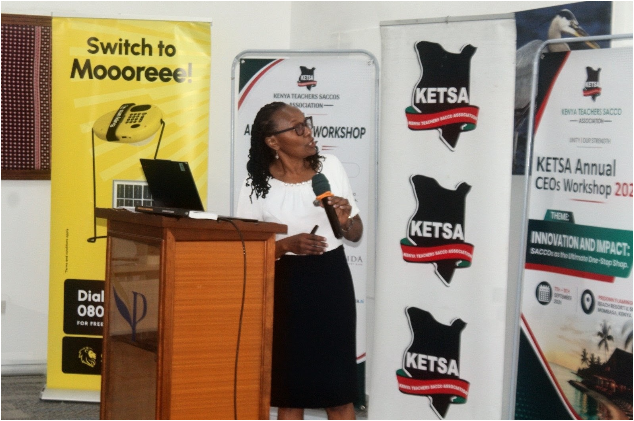
This emerged as a key leadership issue during the KETSA Annual CEOs Workshop 2026, where SACCO chief executives examined strategic leadership, governance and enterprise risk management in an increasingly demanding operating environment.
Ms. Wambui Mbesa, CEO of Relational FS East Africa subsidiary, led the session, bringing together leadership challenges facing SACCOs and practical considerations for executives responsible for steering their institutions.
At the centre of the discussion was the need for a healthy and constructive Board–CEO relationship.
The Board provides oversight, governance and strategic direction, while the CEO and management team implement approved strategies and oversee daily operations. When these responsibilities are clearly understood, accountability and decision-making can improve. Poor communication, mistrust or interference in operational matters, however, can undermine institutional effectiveness.
A healthy relationship does not mean avoiding disagreement. Directors must be able to challenge management and demand accountability, while CEOs should provide professional advice and explain the operational implications of strategic decisions. Communication, transparency and mutual respect are therefore essential.
Navigating a changing risk landscape
SACCO leaders are increasingly dealing with risks that extend beyond traditional financial and credit concerns. Cybersecurity, liquidity pressures, performance targets and institutional reputation are now important considerations at executive and board level.
Cybersecurity is particularly significant as SACCOs expand their use of mobile banking, USSD and other digital platforms to improve member access and service delivery. While technology creates opportunities for greater convenience, it also exposes institutions to threats that can result in financial losses, compromised member information and reputational damage.
Cyber risk can no longer be treated exclusively as an ICT department responsibility. CEOs and directors need to understand their institutions’ exposure and ensure appropriate security controls, staff awareness and incident-response measures are in place.
The challenge is to embrace technological advancement while protecting members and maintaining confidence in the institution.

Balancing growth with sustainability
Performance targets present another challenge for SACCO executives. Boards and members expect growth in membership, lending, income and other areas of institutional performance, placing CEOs under pressure to deliver results.
However, pursuing growth without adequate controls can create longer-term problems. Rapid loan expansion, for instance, may increase income in the short term but weaken asset quality if credit assessment and monitoring are compromised.
Strategic leadership therefore requires CEOs to look beyond headline figures and consider whether growth is sustainable, risks are adequately managed and current decisions strengthen the institution’s future position.
Enterprise risk management must consequently form part of strategic decision-making rather than being treated merely as a compliance requirement.
Liquidity and member confidence
Liquidity management is equally important because members expect their SACCOs to meet financial obligations when due. A failure to do so can undermine confidence and affect the institution’s reputation.
Management must monitor deposits, withdrawals, loan disbursements, investments and other commitments while preparing for unexpected changes in cash flows.
Effective liquidity management involves anticipating potential pressure and establishing appropriate safeguards before a shortage develops. This requires regular monitoring of financial information, prudent planning and timely decisions by management, supported by effective board oversight.

Protecting institutional reputation
For member-owned financial institutions, reputation is a valuable asset built through service delivery, transparency, responsible management and how members are treated.
The rapid spread of information through social media makes reputation management even more important. A service failure, unresolved complaint or cybersecurity incident can quickly attract public attention.
CEOs must therefore foster organisational cultures that prioritise accountability, timely communication and effective complaint resolution. How an institution responds when problems arise can be just as important as preventing them.
Building a lasting leadership legacy
Beyond immediate performance lies a longer-term question: what institution will a CEO leave behind?
Leadership legacy should extend beyond financial results recorded during a particular tenure. It can also be reflected in stronger governance, capable leadership teams, effective risk-management systems, improved technology and sustained member confidence.
This requires executives to balance immediate expectations with decisions that strengthen institutional resilience over time.
The discussions at the KETSA Annual CEOs Workshop 2026 highlight the expanding responsibilities of SACCO chief executives. Modern leaders must be strategists, communicators and risk managers, while working within governance structures that demand accountability.
Ultimately, a SACCO’s ability to navigate uncertainty depends not only on its financial resources or technology, but also on the quality of its leadership and the relationship between those responsible for oversight and those charged with execution.
For SACCO CEOs, the task is clear: deliver today’s results, manage today’s risks and build institutions capable of succeeding tomorrow.