



Mwalimu National Sacco is turning to artificial intelligence (AI), real-time data and digital services to drive its next phase of growth as Kenya’s co-operative movement adapts to a rapidly changing financial landscape.
Chief Executive Officer Kenneth Odhiambo says technology will be central to keeping co-operative institutions competitive and responsive as members increasingly demand faster, more personalised and round-the-clock financial services.
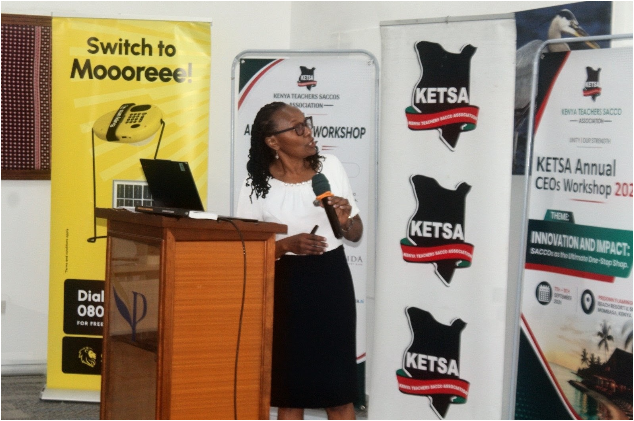
Odhiambo spoke during the 2026 Kenya Teachers SACCO Association (KETSA) Annual CEOs’ Workshop at PrideInn Flamingo Beach Resort & Spa in Mombasa, where technology and the future of the co-operative movement featured prominently.
For Mwalimu National Sacco, the transformation comes as the institution expands beyond its traditional teachers’ membership base to serve professionals in banking, universities, corporations and government institutions, alongside a growing diaspora membership across Europe, North America and Asia.
With operations spanning all 47 counties, the Sacco is increasingly relying on technology to extend its reach, strengthen decision-making and serve a geographically dispersed membership.
From branches to a digital co-operative
Mwalimu National Sacco operates 22 fully operational branches and eight satellite branches, supported by a 24-hour contact centre in Nairobi.
While its physical network remains important, the diversity and geographical spread of its membership mean that branch expansion alone cannot meet every emerging need. Digital platforms offer an opportunity to make services more accessible without requiring members to travel.
For Odhiambo, growth is increasingly about more than opening branches or recruiting members. It also depends on how quickly an institution understands members’ needs, responds to them and delivers reliable services.
This makes data an increasingly valuable management asset.
Real-time data transforms decision-making
Real-time dashboards are changing how Sacco executives monitor performance, replacing some of the delays associated with compiling reports from different branches and departments.
According to Odhiambo, these tools give management faster access to operational information, making it easier to identify emerging issues, track performance and respond promptly.
The shift also reduces time spent on repetitive reporting, allowing employees to focus more on analysis, problem-solving and service improvement.
For an institution operating across all 47 counties, timely information can help management identify variations in branch performance and make decisions based on current operational realities rather than relying exclusively on historical reports.

AI: From fear to opportunity
Artificial intelligence represents another frontier in the Sacco’s digital transformation.
While AI has raised concerns about machines replacing human workers, Odhiambo draws parallels with the introduction of computers into Kenyan workplaces in the early 1990s. Technology changed how people worked and automated routine tasks while creating demand for new technical and analytical capabilities.
Within the Sacco sector, AI could similarly support repetitive processes, analyse large volumes of information and help management identify trends and potential scenarios.
However, its effectiveness depends heavily on the quality of the information available. Fragmented, inaccurate or poorly structured data can limit the value institutions derive from advanced systems.
For Saccos, adopting AI therefore requires more than purchasing software. It calls for reliable data systems, stronger analytics capabilities, relevant employee skills and an organisational culture that supports effective technology adoption.
Keeping members at the centre
Despite the growing emphasis on automation, Odhiambo’s vision remains focused on improving member experience.
Faster processing has limited value if members still struggle to obtain assistance or resolve complaints. Digital channels and the Sacco’s 24-hour contact centre are therefore important to its broader objective of making services more accessible while preserving the human connection associated with co-operative institutions.
Automation can also free employees from repetitive tasks, allowing them to spend more time understanding members’ financial needs and helping them find appropriate solutions.
The goal is not simply to digitise existing processes, but to use technology to make service delivery more responsive and effective.
Leadership must drive transformation
Odhiambo also emphasises the role of leadership and employee engagement in implementing the Sacco’s strategy.
Technology alone cannot transform an institution if employees do not understand its direction or feel connected to its objectives. Leaders must communicate the institutional vision, empower teams to execute their responsibilities and maintain engagement across the organisation.
For a national institution, this includes reaching employees at branch level and understanding the different challenges they face rather than relying entirely on communication from headquarters.
Ultimately, Mwalimu National Sacco’s technology ambitions depend on aligning digital investment with capable employees, sound data management and a clear focus on.