



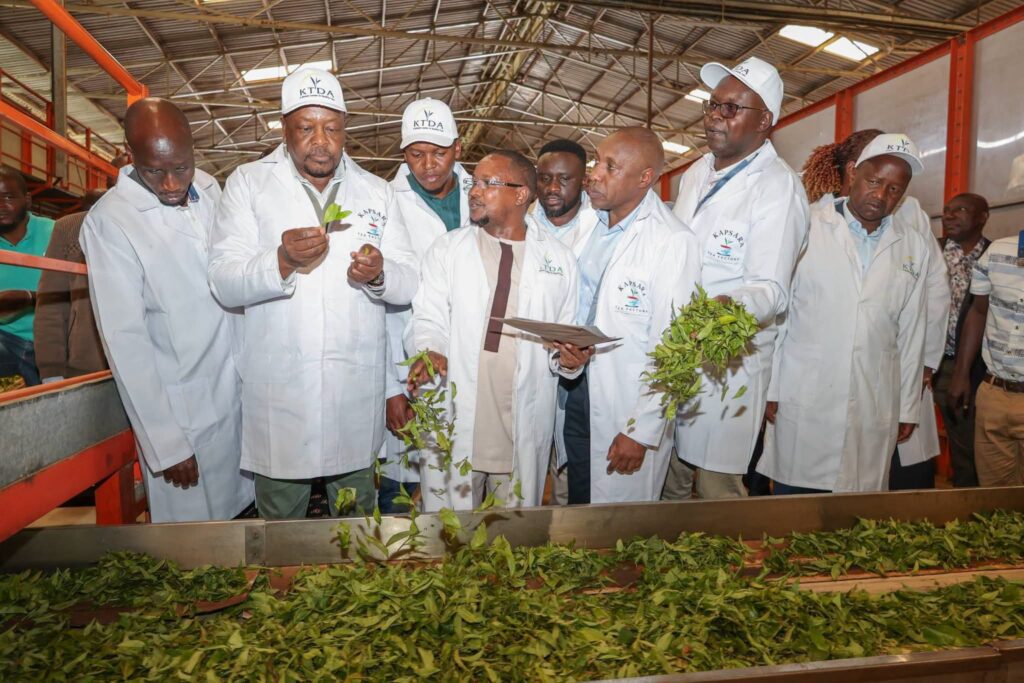
The Government has unveiled fresh measures to boost the incomes of tea and wheat farmers, including a proposed tea levy to strengthen Kenya’s global tea brand and an increase in the producer price of locally grown wheat to encourage domestic production.
Agriculture and Livestock Development Cabinet Secretary Sen. Mutahi Kagwe said the proposed 0.8 per cent tea levy would not be deducted from farmers’ earnings because it will be paid by tea buyers.
The Cabinet Secretary said the levy is intended to address a long-standing market distortion in which countries such as Pakistan, India, Egypt, the United Arab Emirates, Iraq, Iran, Russia and China import Kenyan tea in bulk, blend and repackage it before selling it under their own brands.
He said the practice has prevented Kenya from fully benefiting from the premium value associated with its globally renowned tea despite being one of the world’s leading exporters.
“The levy is meant to ensure Kenyan tea is recognised and marketed as a premium global brand. It will not reduce farmers’ earnings because it will be borne by the buyer,” said Kagwe.
Under the plan, Kenya will establish a Geographical Indication (GI) to protect the identity of Kenyan tea in international markets, enabling exporters to market the product under a distinct Kenyan brand and allowing farmers to earn better returns.
Kagwe dismissed concerns that the levy could discourage international buyers, noting that demand for Kenyan tea remains strong. He cited last week’s tea auction, where 96 per cent of the tea offered for sale was purchased.
Funds collected through the levy will be reinvested into the tea industry, with 50 per cent going directly to farmers, 20 per cent allocated to research and innovation, while the remaining funds will support infrastructure development, marketing and other initiatives aimed at enhancing the competitiveness of Kenyan tea.
In a separate intervention targeting cereal farmers, the Government increased the producer price of locally produced wheat from KSh 4,750 to KSh 5,100 per 90-kilogram bag for the 2026 season.
The revised price follows consultations involving the Agriculture and Food Authority (AFA), the Cereal Growers Association, wheat farmers and the Cereal Millers Association.
The new price will apply at designated aggregation centres as the Government begins purchasing locally produced wheat ahead of any imports.
More than 2,000 wheat farmers in Narok, Nakuru, Meru, Laikipia, Nyandarua and Uasin Gishu counties are expected to benefit from the revised pricing.
The Government said this season’s wheat harvest has declined to about one million bags from 1.7 million bags last year due to adverse weather conditions.
To revive the subsector, it is implementing several interventions, including fertilizer subsidies, farm mechanization, distribution of improved seed varieties, land commercialization, climate-smart agriculture and enhanced pest control.
The twin announcements underscore the Government’s strategy of increasing farmers’ incomes by adding value to agricultural commodities while strengthening local food production and enhancing Kenya’s competitiveness in international markets.
While tea farmers are expected to benefit from stronger branding and greater value in export markets, wheat growers stand to gain from improved producer prices and policies aimed at reducing reliance on imported grain.