



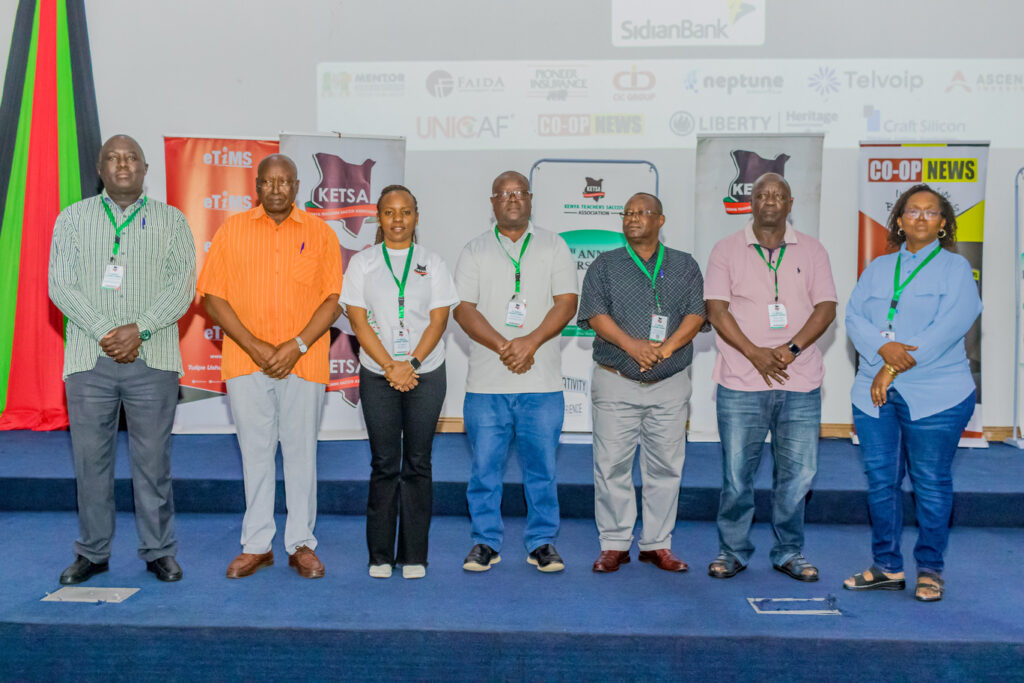
Leaders in Kenya’s teacher-based Sacco movement have been challenged to move beyond digitization as a compliance exercise and embrace innovation, value addition, and regulatory foresight as the defining pillars of the sector’s next growth phase. The call came during the 5th Leadership Conference of the Kenya Teachers SACCOs Association (KETSA) in Kisumu, where policymakers, banking executives, university leaders, and Sacco CEOs convened to interrogate the future of cooperative finance in a rapidly evolving digital economy.
From Technology Spend to Innovation Strategy
Sidian Bank CEO Chege Thumbi framed the moment as a transition point for the industry. “The industry has already invested heavily in technology,” he noted, pointing to core systems, mobile platforms, and digital rails as now commonplace. “The next phase is not technology for its own sake, but innovation and creativity.”
Thumbi emphasized that Sacco leaders must focus on whether their products, processes, and governance models are relevant to the emerging workforce, particularly Gen Z professionals entering teaching and other public service sectors. Sustainability, he added, depends on efficient intermediation between deposits and loans, prudent liquidity management, and diversified revenue streams, essential to withstand intensifying competition from fintechs and digital lenders.
He lauded KETSA’s leadership for proactively engaging the Sacco Societies Regulatory Authority (SASRA), highlighting that early regulatory dialogue enables Saccos to prepare for complex operations, technology investments, and diversified product offerings. “Engaging regulation early allows the industry to address future challenges beyond simple savings and lending,” Thumbi said, noting that compliance can facilitate partnerships to deliver inclusive, value-added services.


Global Lessons in Value Addition
To encourage benchmarking, Thumbi cited cooperative movements in Canada and the Philippines as examples of scale and relevance. He highlighted a Philippine cooperative serving more than five million motorcycle taxi operators, structured around daily micro-contributions equivalent to KSh10. The model integrates savings, credit, health and social insurance, vehicle maintenance, and life cover, delivering convenience and economic security in a single ecosystem.
“It is one of the fastest-growing because it offers value-added services far beyond basic banking,” Thumbi said. “That is the direction Saccos must consider if they are serious about economic empowerment and national prosperity.”
The broader message was clear: future growth will be driven not by balance sheet expansion alone, but by how deeply Saccos embed themselves in the economic lives of members.
Innovation Anchored in Cooperative Principles
Following the chief guest’s address, Kamau Ngamau, Vice Chancellor of Co-operative University of Kenya (CUK), extended the innovation debate into academia and long-term sector capability. He showcased student-led solutions, including a mobile application for farm produce marketing, and recalled a CUK student winning a top award in China during the Huawei Global Competition, illustrating global competitiveness in cooperative-linked innovation.
CUK has expanded its ICT portfolio to include programmes in computer science, software engineering, and cyber security, recently launching Master’s degrees in Cyber Security and Data Science. Ngamau emphasized that these disciplines are critical for safeguarding digital financial systems and enabling analytics-driven decision-making within Saccos.
“Innovation is not just about technology,” he said. “It is about improving services while remaining faithful to cooperative principles.” The university is also preparing for Kenya’s Competency-Based Curriculum (CBC) transition, aligning courses with CBC competencies and career pathways, while outreach initiatives like high school career days and innovation accelerators are building an entrepreneurial pipeline for the sector.

The “One-Stop Shop” Imperative
Across panel discussions, the concept of a Sacco as a comprehensive “one-stop shop” gained traction. Modern Saccos must integrate short-term liquidity solutions, long-term asset financing, investment advisory, retirement planning, insurance, and risk protection, delivered seamlessly through mobile platforms.
Youth-targeted products were flagged as an urgent gap. While teacher Saccos remain trusted institutions, stability alone is no longer sufficient. Members expect instant digital services, real-time responsiveness, and omnichannel access, with technology serving as the foundational enabler. Secure core banking systems, integrated mobile apps, CRM tools, and interoperability with national payment rails like PesaLink are now baseline requirements.
Branding and visibility also emerged as a strategic weakness. Many Saccos innovate internally but fail to communicate advances to the market, losing opportunities to attract new and younger members.
A New Chapter for KETSA
The conference marked a structural milestone for KETSA. Chairperson Robert Njue described the launch of KESECO (KETSA Secondary Cooperative Ltd) as transformative, enhancing liquidity management and supporting smaller or struggling Saccos. He likened the association’s evolution to “giving birth” to new capabilities, positioning KESECO as a mechanism to strengthen resilience within the teacher-based Sacco ecosystem.
The move signals a shift toward a more regulated and robust institutional framework, aligned with tightening SASRA oversight and the growing complexity of Sacco operations.