Kenya’s food security debate has for years revolved around one familiar question: How do we produce enough food to feed a growing population?
But perhaps we are asking the wrong question.
The more important question is: Where can Kenya produce more food, and what must it do to unlock that potential?
The answer should take us beyond the traditional agricultural heartlands and towards the vast Arid and Semi-Arid Lands (ASALs), where millions of Kenyans live and where agricultural potential remains significantly underdeveloped.
If Kenya is serious about building a food-secure nation, the ASALs cannot continue to occupy the margins of agricultural policy.
They must move to the centre of the conversation.
The ASAL counties face some of the country’s most difficult agricultural conditions. Rainfall is scarce and unpredictable. Droughts can wipe out crops and pasture. Water resources are limited, while high temperatures and pests add further pressure on farmers.
These challenges have often reinforced the perception that agriculture in such areas is too risky to be a major contributor to national food production.
That assumption needs to change.
The objective should not be to turn Turkana, Marsabit, Garissa, Wajir, Mandera or other ASAL counties into replicas of Kenya’s high-rainfall agricultural zones.
Rather, Kenya should invest in agricultural systems specifically designed for dryland conditions.
There is already evidence that this approach can work.
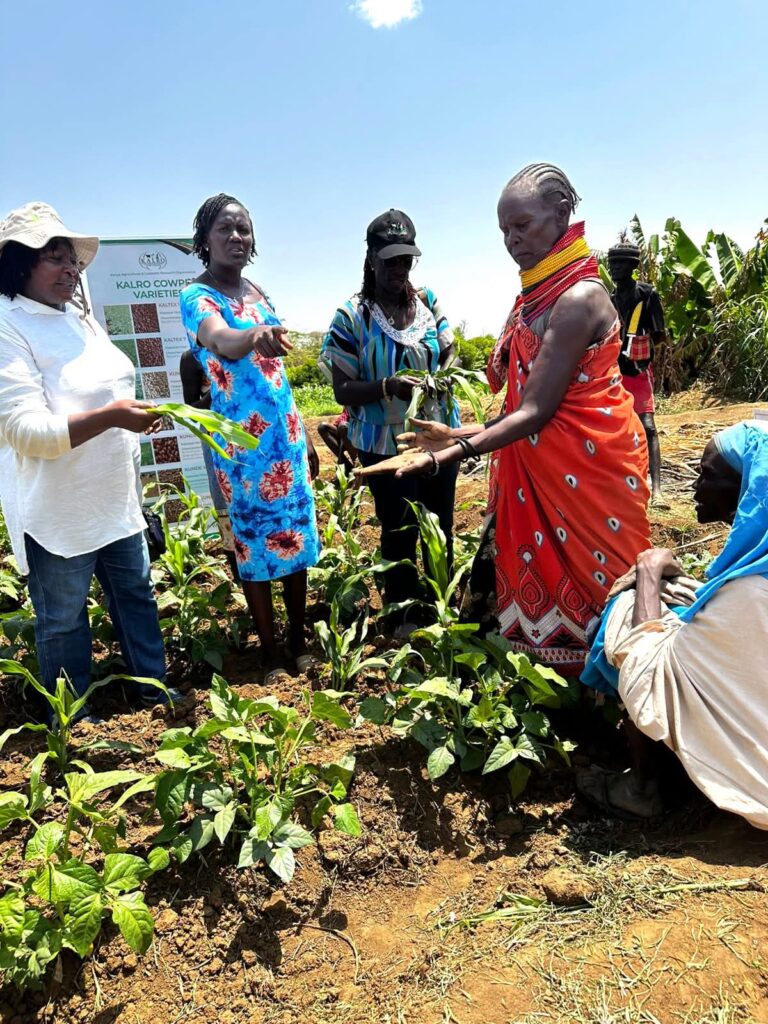
The Kenya Agricultural and Livestock Research Organization (KALRO), through the Food Systems Resilience Project, is supporting farmers in Turkana County with climate-smart agricultural technologies, including improved cowpea technologies and cowpea-sorghum intercropping.
Researchers from KALRO AMRI Katumani recently worked with farmers in Turkwel Ward, Loima Sub-County, monitoring demonstration plots at Nanye Irrigation Scheme and exploring the establishment of another demonstration plot at Napool Irrigation Scheme.
The significance of such initiatives goes far beyond the individual farms involved.
They challenge the idea that ASAL communities must remain permanent consumers of food produced elsewhere.
With appropriate crops, irrigation, agronomic knowledge and technology, dryland farmers can become producers capable of contributing to local food supplies and markets.
That is precisely the mindset Kenya needs.
From relief to production.
For many ASAL communities, food insecurity has historically been addressed through emergency interventions.
When drought strikes, relief food is distributed. When livestock die, assistance is provided. When water sources dry up, emergency water supplies are mobilised.
Such interventions save lives and remain necessary during crises.
But there is a fundamental difference between responding to food insecurity and building food security.
One treats the symptoms.The other strengthens the capacity of communities to produce and withstand shocks.
Kenya needs to do both, but the balance must increasingly shift towards long-term resilience.
Every shilling spent helping a farmer produce food under difficult climatic conditions can potentially reduce future dependence on emergency assistance.
This is why agricultural research, irrigation, extension services and climate-smart farming should be regarded as food security infrastructure.
Water must become a national priority. No serious conversation about agriculture in ASAL counties can avoid the question of water.
The greatest agricultural asset in many dryland areas may not be rainfall but the ability to capture, store and efficiently use available water.
Irrigation schemes such as those in Turkana demonstrate what becomes possible when water is deliberately brought into agricultural production.
But irrigation infrastructure alone is not enough.
Farmers need suitable crops, efficient irrigation technologies, access to inputs, technical advice and reliable markets.
This is where agricultural research institutions have an important role.
The experience at Nanye and Napool shows the value of combining irrigation with research, demonstration plots and farmer training.
The model deserves greater attention across ASAL counties.Climate change makes the argument stronger.
The case for investing in ASAL agriculture becomes even more compelling as climate change continues to disrupt traditional farming systems.
Rainfall patterns are becoming less predictable. Droughts are becoming a recurring threat. Farmers across the country are increasingly being forced to produce food under conditions for which conventional farming practices were never designed.
In this environment, what Kenya learns in its drylands could eventually benefit the entire country.
Climate-smart agriculture developed for ASAL conditions can provide lessons in water efficiency, drought tolerance, crop diversification, soil management and risk reduction that may become increasingly relevant in other parts of Kenya.
The ASALs should therefore not be viewed merely as beneficiaries of climate adaptation.
They can become laboratories for the country’s agricultural future.
Farmers need knowledge, not just inputs.
Another lesson from the Turkana initiative is that technology alone does not guarantee productivity.
Farmers participating in the demonstrations received training on Good Agronomic Practices, including timely thinning of sorghum, pest and disease management, field sanitation and early pest scouting.
Stem borers were identified as a major threat to sorghum, highlighting the importance of early detection and timely intervention.
This illustrates a critical weakness in many agricultural programmes: too much attention is sometimes given to distributing inputs and too little to ensuring farmers know how to use them effectively.
A farmer given improved seed without adequate knowledge may still obtain poor yields.
A farmer provided with irrigation without proper water-management skills may waste scarce water.
A farmer with access to a market but without sufficient production knowledge may fail to meet quality or volume requirements.
Food security therefore requires an ecosystem, not isolated projects.