



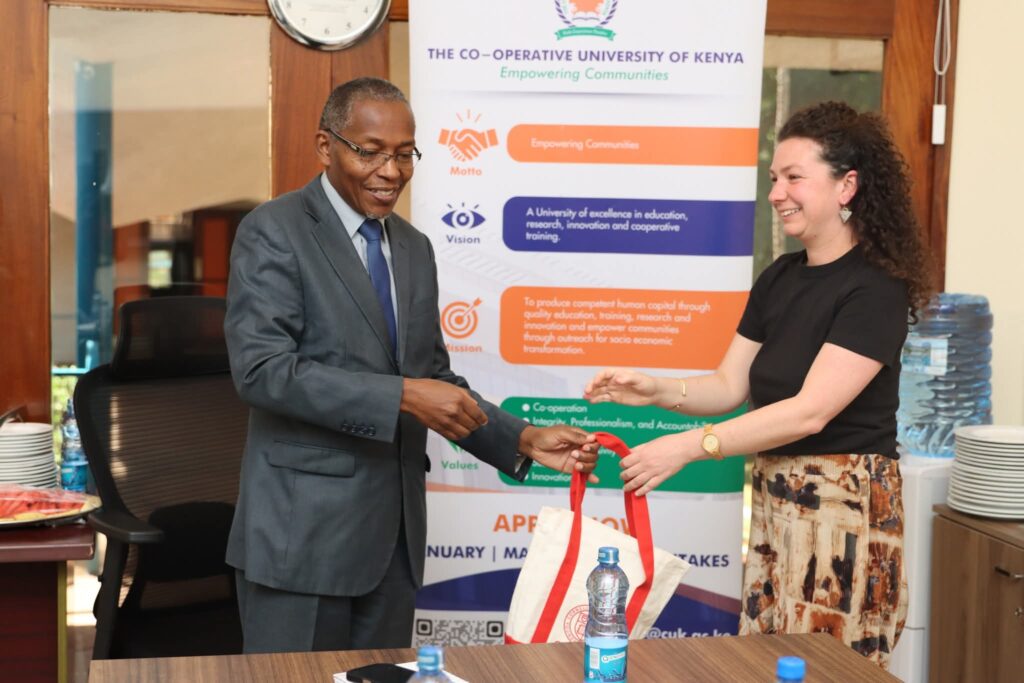
At the 5th Leadership Conference of the Kenya Economic Teachers Association (KETSA), the Vice Chancellor of the Co-operative University of Kenya (CUK), Kamau Ngamau, delivered a forward-looking address urging Saccos—particularly teachers’ Saccos—to embrace innovation, digital transformation and youth-focused strategies to remain competitive in a rapidly evolving financial landscape.
CUK Students Driving Practical Innovation.
Prof. Ngamau highlighted the growing technological capability of CUK students, noting that innovation at the university is not theoretical but solution-driven.
“Our students are building practical tools that respond directly to market needs,” he said, citing the development of a mobile application that links farmers to markets for their produce.
The Vice Chancellor also pointed to global recognition achieved by the university. Three years ago, a CUK student won a top award in China at the Huawei Global Competition—an achievement he described as proof that Kenyan cooperative education can compete on the world stage.
To strengthen this momentum, CUK offers specialised ICT programmes in computer science, software engineering and cyber security. The university has recently launched Master’s programmes in Cyber Security and Data Science—fields he described as critical for modern financial operations, especially for regulated institutions such as Saccos.
In 2025, the university expanded its innovation footprint by inviting high school students to an Innovation Skills Accelerator focused on entrepreneurship. CUK also co-hosts an annual Innovation Week, where student innovators pitch solutions to corporate challenges.
“This is how we nurture a pipeline of problem-solvers who can serve the cooperative movement,” he said.
Preparing for CBC University Entrants.
With the first cohort of Competency-Based Curriculum (CBC) learners expected to join universities in 2029, Prof. Ngamau said CUK is proactively aligning its systems and programmes.
“We are revising our courses to match CBC competencies and career pathways,” he noted.
The university is already engaging high schools through career days and academic modules that demonstrate how subjects such as Business Studies and Information Technology connect directly to university programmes and cooperative careers.
The ‘One-Stop Shop’ Sacco Model.
Turning to the cooperative sector, the Vice Chancellor emphasised that innovation must go beyond adopting technology.
“Innovation is not just about gadgets and apps. It is about improving services while remaining faithful to cooperative principles,” he said.
Drawing lessons from the success of credit unions in Canada, he outlined what he termed the “one-stop shop” Sacco model. Such an institution, he argued, must provide:
- Liquidity solutions for both short-term loans and long-term asset financing.
- Investment advisory services and retirement planning.
- Insurance and risk protection products.
- Seamless digital platforms for member convenience.
- Youth-targeted financial products to address what he described as a previously “missing segment” in cooperative offerings.
A Wake-Up Call for Teachers’ Saccos.
Prof. Ngamau observed that while teachers’ Saccos remain among the most trusted financial institutions in Kenya, stability alone is no longer enough.
“Members now expect instant digital services,” he warned.
He noted that fintech firms are aggressively targeting Sacco members, often through unsolicited digital product advertisements. To remain competitive, Saccos must enhance their digital capabilities and improve customer experience.
At the same time, regulatory oversight is tightening. Compliance with the Sacco Societies Regulatory Authority (SASRA) is becoming more stringent, making it imperative for Saccos to strengthen governance, risk management and digital readiness.
Building a Pan-African Cooperative Innovation Hub.
In a move aimed at strengthening regional collaboration, CUK has formalised joint research programmes with the Moshi Co-operative University in Tanzania. The partnership seeks to build a Pan-African cooperative innovation hub focused on research, technology and best practices for cooperative enterprises.
Prof. Ngamau concluded by urging cooperative leaders to think beyond traditional models and prepare their institutions for a digitally driven future. “The cooperative movement has always been about people working together to solve shared problems,” he said. “Our task now is to ensure we use technology, research and innovation to serve members better—without losing our cooperative identity.”