

When Juma Omar and Salim Karisa sat side by side in their college classroom four years ago, the future appeared straightforward. Study hard. Graduate. Get a job. That was the promise they had grown up believing.
The two friends enrolled for a diploma in Public Relations, a course they pursued with enthusiasm and determination. They excelled academically, earning some of the highest scores in their class. Their lecturers praised them. Their certificates seemed to be passports to a better life.
Yet today, instead of drafting corporate communication strategies in air-conditioned offices, the two young men spend their days selling second-hand clothes. And surprisingly, neither regrets the journey that brought them here.
“We believed that after graduation, the next logical step was employment,” recalls Omar. “I thought I would get a job and immediately start earning a salary.”
Like many students, he viewed education as a bridge leading directly into the professional world. It was a belief reinforced by years of schooling, encouragement from teachers, and societal expectations.
But reality had different plans.
Months after graduation turned into years. Applications were sent. CVs were revised and updated countless times. Cover letters were carefully crafted. Interviews remained elusive.
Two years later, the dream that once seemed so certain had begun to crumble.
“The more I applied, the more I realized that life could not stop while I waited,” says Omar.
At first, the realization was painful. He had invested years in education and expected a return. Yet the labour market appeared indifferent to his qualifications and determination.
Eventually, something changed.
Instead of continuing to cling to a single vision of success, Omar began questioning the assumptions he had carried from college.
Life, he realized, was not unfolding according to the script he had been given.
Meanwhile, his friend Salim Karisa had reached a similar conclusion, though his awakening came even earlier. For Karisa, the warning signs appeared while he was still a student. To complete his diploma, he needed an industrial attachment. Armed with the required documents, he applied extensively to organizations and companies.
Nothing materialized. The attachment that seemed like a simple graduation requirement became a major obstacle. Unable to secure placement within the required timeframe, Karisa’s graduation was delayed by an entire year.
“It was my first encounter with the reality outside school,” he says. After eventually graduating, Karisa moved to the city and stayed with a relative while pursuing what he calls his “dream job.”
For six months he knocked on doors, submitted applications, and waited for responses that rarely came. Then he made a decision that would alter the course of his life. “Survival matters more than a white-collar job,” he says. Rather than continue waiting indefinitely, Karisa approached his relative for help. He was lent Ksh 2,000, a modest amount that would become the foundation of his entrepreneurial journey.
With the money, he headed to Kongowea Market. He bought about fifteen second-hand T-shirts and began walking through the streets, selling them at a small profit. It was humble work. It lacked the prestige often associated with diploma holders. Yet it generated something the job applications never had: income. Slowly, customers began returning. Word spread. Sales improved.
Months later, he had accumulated enough capital to rent a small stall and establish a permanent business location. As his business grew, he encouraged Omar to consider the same path. The idea initially represented a significant departure from everything they had envisioned during college. Yet Omar was already beginning to recognize that economic survival sometimes requires flexibility. He took the leap.
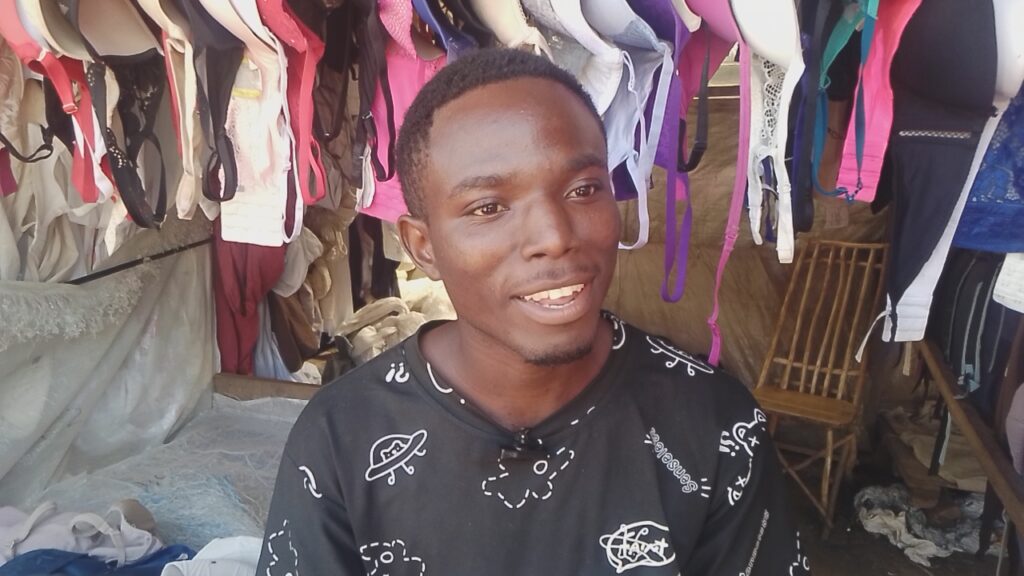
Today, the two friends operate neighbouring stalls, selling second-hand clothes to customers from different walks of life. The irony is not lost on them. Years ago, they imagined sharing office space in a corporate building. Instead, they share a marketplace. But what once seemed like a detour now feels like progress.
Their stalls may not resemble the careers they studied for, yet they represent something equally valuable: independence. Their story reflects a broader reality confronting many young Kenyans. Every year, thousands of graduates leave colleges and universities armed with qualifications, ambition, and expectations. Yet many enter a labour market unable to absorb them.
For some, the experience becomes a source of frustration and disappointment. Others spend years waiting for opportunities that may never come. Omar and Karisa chose a different response. Rather than viewing entrepreneurship as a consolation prize, they embraced it as a legitimate path forward. In doing so, they challenged one of society’s most persistent assumptions: that success only wears a necktie and sits behind a desk.
The two friends still value their education. Neither believes their studies were wasted. Public Relations taught them communication skills, customer engagement, confidence, and professionalism, qualities they now use daily in business. What changed was not their respect for education but their understanding of how success can be achieved.
Today, their ambitions stretch far beyond the small stalls where they started. Together, they dream of opening a large clothing outlet and eventually importing second-hand clothes directly from China and India. They speak about expansion, investment, and building a business empire that can employ others. Their vision is no longer tied to waiting for an employer’s call. It is tied to creating opportunities themselves. Standing among racks of colourful shirts and trousers, the two friends embody a generation learning to navigate an economy that rarely follows the promises made in classrooms.
Their journey is not a story about abandoning dreams. It is a story about adapting them. In a world where economic realities often refuse to cooperate with academic expectations, Omar and Karisa have discovered an important lesson: education opens minds, but survival sometimes requires rewriting the script.
And for these two young entrepreneurs, that rewritten script may ultimately lead to a future bigger than the one they originally imagined.