



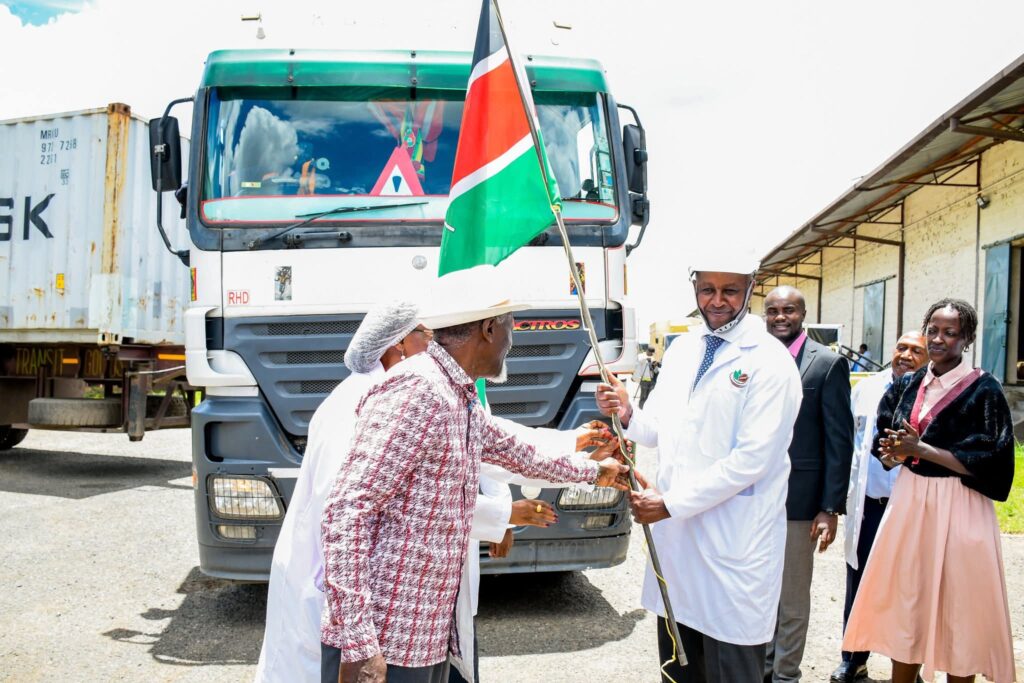
Kenya has taken a decisive step toward aligning its agricultural exports with emerging global sustainability standards following the flag-off of New Kenya Planters Cooperative Union (New KPCU)’s first consignment of coffee compliant with the European Union Deforestation Regulation (EUDR) to Poland.
Presiding over the event, Principal Secretary for Cooperatives Patrick Kilemi described the shipment as a significant milestone in the country’s journey toward sustainable, traceable, and globally competitive agricultural exports. He noted that the achievement underscored Kenya’s readiness to adapt to increasingly stringent international trade requirements, particularly within the European market, one of the country’s key coffee destinations.
Kilemi indicated that the successful compliance with EUDR requirements was not an isolated effort, but rather the result of coordinated collaboration among government agencies, farmers, cooperative societies, and development partners. He pointed out that investments in farmer training, digital traceability systems, and compliance frameworks had played a central role in enabling the shipment.
The EUDR framework requires exporters to demonstrate that commodities such as coffee are not linked to deforestation or forest degradation. For Kenya, where smallholder farmers dominate coffee production, this introduces both a challenge and an opportunity. Ensuring traceability from farm to export point demands a level of organization and record-keeping that many individual farmers may struggle to achieve independently—placing cooperative societies at the center of compliance efforts.
New KPCU, as a national cooperative union, becomes a critical vehicle in this transition. By aggregating produce from thousands of small-scale farmers, the cooperative is able to implement standardized systems for monitoring, verification, and certification. This not only reduces the compliance burden on individual farmers but also enhances their access to premium international markets.
Experts note that this development reinforces the strategic importance of cooperatives within Kenya’s agricultural value chains. Historically, cooperatives have provided farmers with access to credit, inputs, and markets. Under the new global trade environment, their role is expanding to include governance of sustainability standards and digital traceability systems.
The government’s involvement, as highlighted by Kilemi, signals a policy shift toward supporting compliance-driven agriculture. By facilitating partnerships with development organizations and investing in infrastructure for traceability, the state is positioning itself as an enabler of market access rather than merely a regulator. This approach aligns with broader national goals of increasing export earnings while ensuring environmental conservation.
Development partners have also emerged as key stakeholders in this transition. Their support in capacity building and technology transfer has helped bridge the gap between global regulatory expectations and local production realities. Through training programs and pilot projects, farmers are being equipped with the knowledge and tools required to meet EUDR standards, including geolocation mapping of farms and documentation of land-use practices.
For farmers, the implications are far-reaching. Compliance with EUDR opens access to high-value European markets, potentially translating into better prices and more stable demand. However, it also requires adherence to stricter production practices, which may involve additional costs and changes in traditional farming methods. Cooperatives, therefore, play a crucial intermediary role in cushioning farmers during this transition.
The shipment to Poland also highlights Kenya’s effort to diversify and strengthen its export markets within Europe. As global consumers become increasingly conscious of environmental sustainability, compliance with regulations such as EUDR is likely to become a baseline requirement rather than a competitive advantage.
Kilemi emphasized that Kenya’s commitment goes beyond market access. He noted that aligning with EUDR reflects the country’s broader dedication to responsible trade and environmental stewardship. By ensuring that agricultural expansion does not come at the expense of forests, the policy framework supports long-term ecological sustainability while safeguarding livelihoods.
Analysts observe that this milestone could set a precedent for other agricultural value chains in Kenya, including tea, cocoa, and timber-related products, which are also affected by EUDR requirements. The success of New KPCU may therefore serve as a model for scaling compliance across the sector.
Ultimately, the flag-off of the EUDR-compliant coffee shipment illustrates the intersection of agriculture, environmental policy, and cooperative enterprise in shaping Kenya’s economic future. As global trade rules evolve, the country’s ability to leverage its cooperative movement and institutional partnerships will determine how effectively it navigates the transition toward sustainable and inclusive growth.